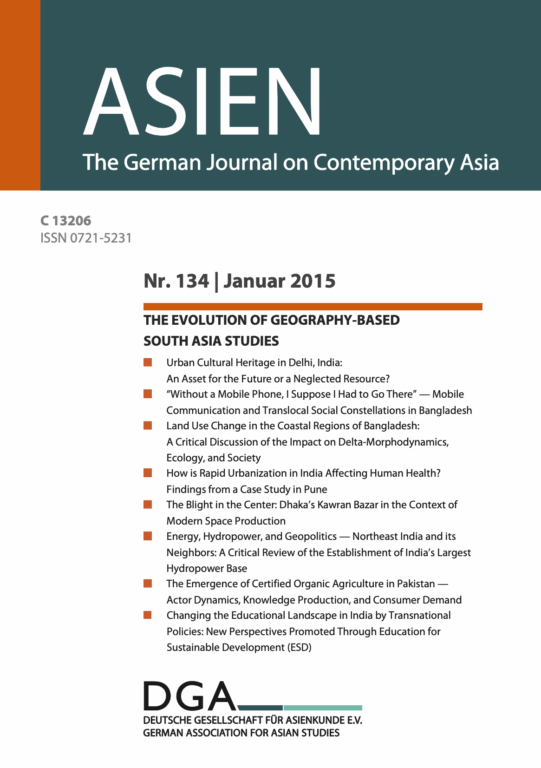
Nr. 134 (2015) Editorial 5–8 {:en} The Evolution of Geography-based South Asia Studies Geography as a scientific discipline in Germany forms a longstanding tradition in research on South Asia. Traditionally the focus of German geographers was on landscapes, understood as entities consisting of natural (for example surface structures, soils, and vegetation) and anthropogenic (such as settlements and cultivated areas) elements. These different elements were analyzed within large-scale contexts … von by und and Mareike KrollThemenschwerpunkt Feature Nr. 134 (2015) Artikel Article 9–29 {:en} Urban Cultural Heritage in Delhi, India: An Asset for the Future or a Neglected Resource? The attractiveness of cities and their national and international competitiveness are partly determined by “soft” and “intangible” factors: cultural, social, and individual aspects are becoming the basis for the “unique competitive edge” that cities have and play a crucial role with regard to the creation of identity. In Delhi, every epoch of the city’s rich … von by und and Frauke KraasThemenschwerpunkt Feature Nr. 134 (2015) Artikel Article 31–46 {:en} “Without a Mobile Phone, I Suppose I Had to Go There” Mobile Communication and Translocal Social Constellations in Bangladesh Recent estimates put the global number of mobile phone subscriptions close to the number of humans currently alive on Earth; at the same time, the global number of both domestic and international migrants is approaching the one billion mark. This article addresses the linkages between these two processes: Although migrants and mobile populations always had … von by Themenschwerpunkt Feature Nr. 134 (2015) Artikel Article 47–71 {:en} Land Use Change in the Coastal Regions of Bangladesh: A Critical Discussion of the Impact on Delta-Morphodynamics, Ecology, and Society The article discusses various internal and external factors influencing the environmental and socioeconomic changes that have occurred in the coastal regions of Bangladesh, changes that have led to significant human displacement and migration. The transformation in traditional land use patterns, and specifically from rice farming to export-oriented shrimp cultivation for the growing global market, can … von by Themenschwerpunkt Feature Nr. 134 (2015) Artikel Article 95–120 {:en} The Blight in the Center: Dhaka’s Kawran Bazar in the Context of Modern Space Production The focus of this article is on the planned relocation of Kawran Bazar, the largest traditional food market of Dhaka, Bangladesh, from the city center to three new locations on the urban periphery. We are interested in this specific case as the plans for relocating and decentralizing the market are by now already 20 years … von by und and Markus KeckThemenschwerpunkt Feature Nr. 134 (2015) Artikel Article 121–42 {:en} Energy, Hydropower, and Geopolitics — Northeast India and its Neighbors: A Critical Review of the Establishment of India’s Largest Hydropower Base India’s demand for electricity has recently been increasing at one of the fastest rates of any country in the world. Among renewables, hydropower plays a crucial role as a mature, cost-effective, and reliable power generation technology. India’s Northeast (Brahmaputra Basin) holds an immense hydropower potential of 63 gigawatts, which to this day remains virtually untapped. … von by Themenschwerpunkt Feature Nr. 134 (2015) Artikel Article 143–65 {:en} The Emergence of Certified Organic Agriculture in Pakistan — Actor Dynamics, Knowledge Production, and Consumer Demand Certified Organic Agriculture (COA) is a much debated alternative to conventional and industrialized farming, with recent scholarship having paid attention to different aspects of organic commodities within a global agrofood system. Organic standards link consumers in the Global North with producers in the Global South, and transport agricultural knowledge around the global. For farmers in … von by Themenschwerpunkt Feature Nr. 134 (2015) Artikel Article 167–92 {:en} Changing the Educational Landscape in India by Transnational Policies: New Perspectives Promoted Through Education for Sustainable Development (ESD) Transnational educational policies are challenging current pedagogic practices in India. The United Nations Decade of “Education for Sustainable Development” (UNDESD, 2005 to 2014) is based on constructivist concepts of learning, and encourages the ongoing transformation from an authoritarian to a participative, student-oriented teaching methodology. The implementation of this global educational initiative in a local developing … von by und and Erach BharuchaThemenschwerpunkt Feature Nr. 134 (2015) Editorial 193 {:en} Obituary — Professor Dr. Hans-Georg Bohle Professor Dr. Hans-Georg Bohle died suddenly and unexpectedly in September 2014 last weekend. He was 66 (03.03.1948–20.09.2014). As an internationally renowned human geographer and expert on social vulnerability research, he dedicated his academic life to deciphering the sociospatial production of poverty and exclusion in the Global South. We have lost a captivating teacher and advisor, … von by und and Theresa Fabian Nr. 134 (2015) Neuere Literatur 218–25 {:de} Neuere Literatur über Asien Die Mitglieder der DGA sind herzlich aufgefordert, ihre neuesten Veröffentlichungen der Redaktion zu melden.
Social Movements in Theory and Practice: Concepts and Experiences from Different Regional Contexts, University of Zurich, 24.–25. October 2014 (Silva Lieberherr)
Third Conference on Bengal Related Studies for Students and Young Scholars, Halle (Saale), 24.–26. October 2014 (Sukla Chatterjee)
Jahrestagung der Deutschen Vereinigung für Chinastudien, Universität Münster, 07.–11. November 2014 (Isea Cieply)
Jahrestagung des Arbeitskreises Südostasien in der Deutschen Gesellschaft für Geographie, Köln, 14.–15. November 2014 (Gerrit Peters, Frauke Kraas und Javier Revilla Diez)
Rolf Zeiler: Asien mit Anzug und Krawatte (Eva Schwinghammer)
Srinath Raghavan: 1971. A Global History of the Creation of Bangladesh (Jürgen Stetten)
Arndt Michael: India’s Foreign Policy and Regional Multilateralism (Armin Müller)
Martin Großheim: Die Partei und der Krieg. Debatten und Dissens in Nordvietnam (Christoph Giebel)
Nicholas Herriman: The Entangled State. Sorcery, State Control, and Violence in Indonesia (Friederike Trotier)
Yong Wook Lee, Key-young Son (Hgg.): China’s Rise and Regional Integration in East Asia: Hegemony or Community? (Nick Gemmell)
Hubert Heinelt (Hg.): Modernes Regieren in China (Matthias Stepan)
Robert Heuser, Daniel Sprick: Das rechtliche Umfeld des Wirtschaftens in der VR China (Judith Schöne)
Tim Pringle: Trade Unions in China. The Challenge of Labour Unrest (Günter Schucher)
Jörn Keck, Dimitri Vanoverbeke, Franz Waldenberger (Hgg.): EU-Japan Relations, 1970–2012. From Confrontation to Global Partnership (Frank Rövekamp)
Steven Chung: Split Screen Korea. Shin Sang-Ok and Postwar Cinema (Martin Abraham)
ISSN → 0721-5231 / eISSN → 2701-8431