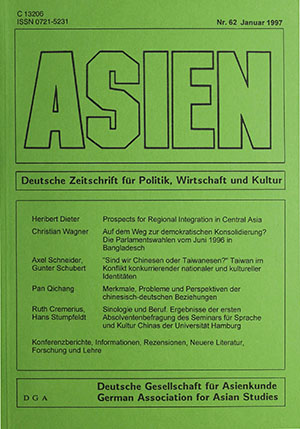
„Sind wir Chinesen oder Taiwanesen?“ Taiwan im Konflikt konkurrierender nationaler und kultureller IdentitätenAxel Schneider und and Gunter Schubert
ASIEN – Nr. 62 (1997) pp. 46–67
Based on qualitative interviews conducted in Taiwan in August/September 1995 this article attempts at a classification of different points of view on the question of the national and cultural identity of Taiwan. We distinguish four basic attitudes: 1) The radical pro-independence position opting for separate Taiwanese nation (e.g. Jiangguodang). 2) A moderate pro-independence position assuming that Taiwanese are culturally Chinese but should live in an independent political state (e.g. parts of the Minjindang). 3) The position of the mainstream-faction of the KMT, Which tries to preserve the status quo and to gain international recognition for the Republic of China. Albeit opting for the long-term goal of reunification under Taiwanese terms, this position can be called pragmatic pro-Taiwanese. 4) The point of view of the New China Party and the anti-mainstream faction of the KMT opting for a Chinese reunification under the name of the Republic of China.
At the end of the article we arrive at four preliminary conclusion: 1) The previous ethnic conflict between Mainlanders and Taiwanese is more and more replaced by a conflict on cultural and national identity. 29 The political system in the ROC on Taiwan is increasingly organized along these lines of varying identities. 3) Since Taiwan has no influence on the development in the PRC and because of the fact that the conflict on Taiwanese identity is an important factor in the struggle between different political parties, the international context is partly neglected within the discourse on identity. 4) One important factor for the emergence of a Taiwanese identity is the congruence of center and periphery after the central government fled to Taiwan in 1949.