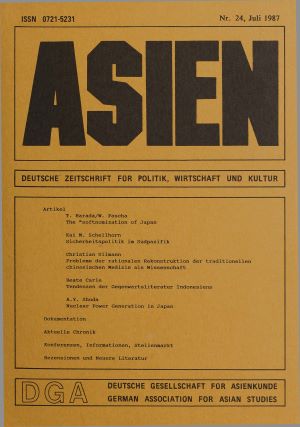
Sicherheitspolitik im SüdpazifikKai Michael Schellhorn
ASIEN – Nr. 24 (1987) pp. 14–32
In recent years the Pacific has not been quiet in the realm of politics. Several interlocking, dynamic streams of development have to be noticed. The South Pacific has experienced resp. is going through a phase of decolonization. The newly independent Archipelago states are partly governed by younger, nationalist-minded politicians whose orientation towards the West is weaker than that of the previous generation of political leaders. The inclination to approach the Group of Blockfree Nations is increasing, and the Soviet Union is accepted as trade partner. A second line of development can be seen in the anti-nuclear policy of the member states of the South-Pacific Forum. Strong Opposition is voiced against both the French nuclear tests on Muroroa and the American nuclear-fuelled or atomic bomb-bearing ships. The denuclearization policy is closely connected with the present crisis of the ANZUS defence treaty. Another problem is related with the strategically important military armament of the Soviet Union. In this context the Soviet naval basis in the Vietnamese harbour of Cam Ranh and the future status of the American military bases in the Philippines are discussed particularly under auspices of the superpower rivalry in the Pacific. (Red.)